

Painel acústico tipo «sanduíche» de lã de rocha perfurada
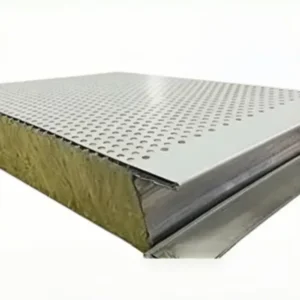
Glostar’s perforated rockwool acoustic sandwich wall panel is engineered specifically for noise control in industrial buildings — protecting employee hearing and health while meeting environmental noise standards. A patented half-punching process on the inner steel facing delivers strong noise reduction without sacrificing structural strength, matching the load-bearing performance of standard, non-perforated sandwich panels.
Description
Loud workshops(such as, KTV), factories, and processing plants create noise levels that can damage hearing, reduce productivity, and violate local environmental noise regulations. The perforated rockwool acoustic sandwich wall panel addresses this directly: the inner steel facing is precision-punched at an engineered hole pattern, backed by a durable water-repellent non-woven fabric, then bonded onto a high-density hydrophobic rock wool core. Sound waves pass through the perforations and are absorbed within the porous rock wool structure rather than reflecting back into the workspace — turning the wall itself into an acoustic treatment, not just a thermal envelope.

Because rock wool — not polyurethane or glass wool — is used as the core material, the panel combines genuine sound-absorbing performance with Class A fire resistance, making it suitable for demanding industrial environments where both noise control and fire safety are required.
Specification
| Effective Width | 1000mm |
| Espessura | 50mm / 75mm / 100mm (additional thicknesses available) |
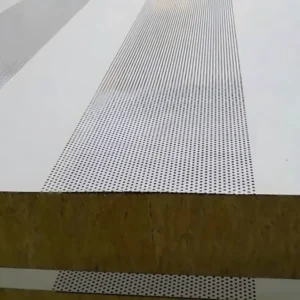
| Inner Steel Plate | Punched, color-coated steel, 0.5-0.6mm, flat rib profile — 3mm hole diameter, 5mm hole spacing, 60° hole arrangement, 32.7% open-hole rate |
| Perforated Face Covering | High-durability water-repellent non-woven fabric |
| Core Material | High-quality hydrophobic rock wool, 100-120 kg/m³ |
| Outer Steel Plate | High-grade color-coated steel, 0.6-0.7mm, ripple profile |
| Joint Type | Concealed tongue-and-groove joint (0/20mm gap) |
| Fixing Method | Hidden-nail (concealed) installation |
| Cor | Customized to project specification |
Acoustic Performance
Sound Absorption (50mm thickness)
| Noise Reduction Coefficient (NRC) | 0.75 |
| Average Sound Absorption Coefficient (100-5000 Hz) | 0.64 |
| High-Frequency Absorption (3150-5000 Hz) | 0.68 |
Sound Insulation (50mm thickness)
| Weighted Sound Insulation (Rw) | 34 dB |
| High-Frequency Sound Insulation (3150-5000 Hz) | 40-50 dB |
In practice, this level of performance can reduce workshop noise sound pressure by roughly one-third — bringing typical industrial noise down from levels comparable to a loud factory floor to a quieter, more tolerable working environment.
The Engineering Behind the Acoustic Design
Every design choice in this acoustic sandwich panel is based on the physics of how porous materials absorb sound:
Full-spectrum acoustic testing: Panel design is based on professional acoustic spectrum analysis across the full 20Hz-20,000Hz human hearing range.
Optimized hole pattern: Hole type and spacing are selected specifically for their sound-absorption characteristics, not just manufacturability.
Balanced-frequency punching layout: Punched strips run along the panel’s length in a 250mm strip width across the 1000mm panel, balancing low-, mid-, and high-frequency absorption.
Selective bonding: Adhesive is applied only in non-punched areas, preserving the open-pore structure needed for porous sound absorption to work.
Rock wool core, not PU or glass wool: Rock wool’s fiber structure is specifically selected for its sound-absorption behavior, distinguishing this panel from standard PU or glass wool sandwich panels.
Structural equivalence: Despite the perforations, bending load capacity is essentially the same as a non-punched panel, so acoustic performance doesn’t come at the cost of structural reliability.
Applications
These sound insulation sandwich panels are ideally suited for factories and workshops containing mechanical, pneumatic, or electromagnetic noise sources—such as fans, compressors, crushers, generators, and machine tools. They are also appropriate for processing plants, testing facilities, and any industrial building requiring indoor noise reduction for reasons of employee health, regulatory compliance, or operational comfort. Additionally, they are suitable for venues such as karaoke lounges and churches.
Frequently Asked Questions
How much noise reduction can I expect from this panel?
At 50mm thickness, the panel achieves an NRC of 0.75 and weighted sound insulation of 34dB, which in practice can reduce workshop noise sound pressure by roughly one-third.
Does perforating the steel facing weaken the panel?
No. The bending load-carrying capacity of the perforated panel is essentially the same as an ordinary, non-punched sandwich panel, so structural performance is not compromised.
Why is rock wool used instead of PU foam or glass wool?
Rock wool’s fibrous, open-cell structure is specifically effective at porous sound absorption, and it also delivers Class A fire resistance — a combination PU foam cores cannot match.
What thicknesses are available?
Standard thicknesses are 50mm, 75mm, and 100mm, with additional options available on request depending on your acoustic and thermal requirements.
What is the minimum order quantity?
MOQ is 500 square meters. Contact our sales team with your project details for a tailored quote and lead time.
Obtenha um orçamento imediato